
Zoom Music
Theory
Lessons
Lessons from anywhere in the world. No travel needed — just a webcam, a good internet connection, and Zoom installed on your device.
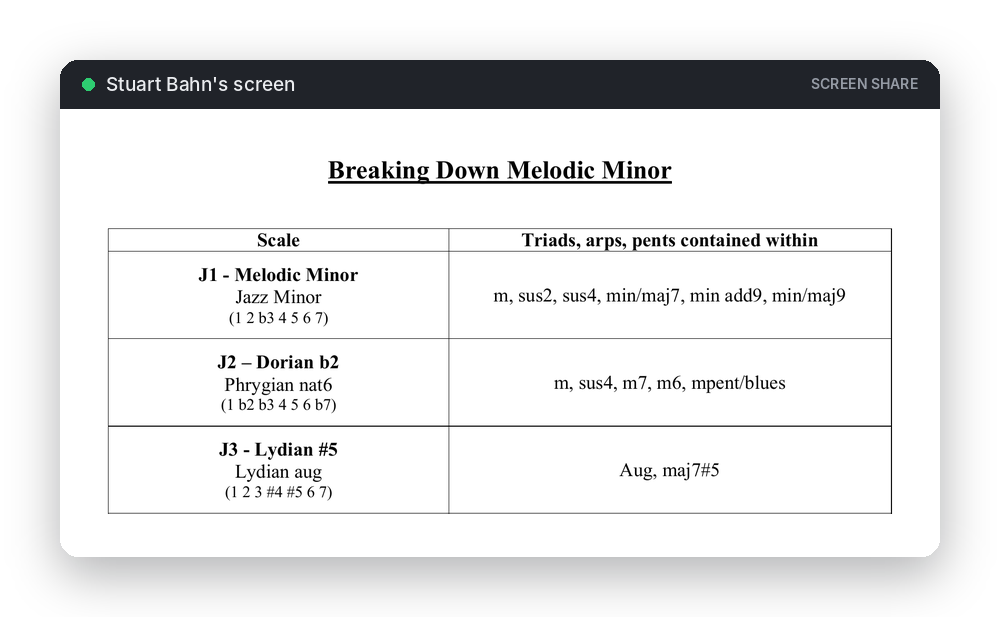
SCREEN-SHARED MELODIC MINOR
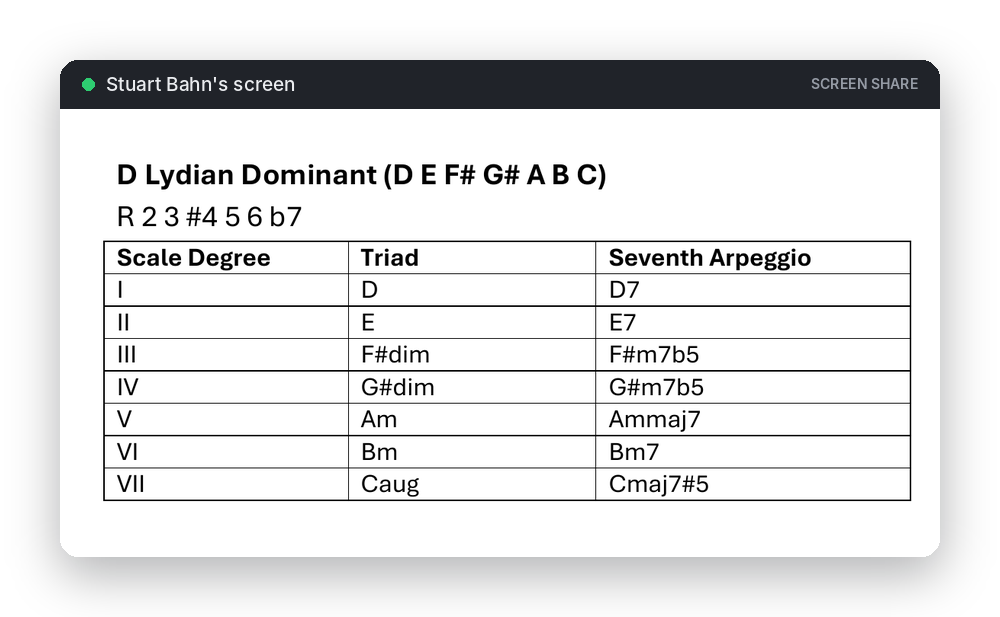
SCREEN-SHARED LYDIAN DOMINANT
How it works
Screen-share in real time
Relevant material — explanations, exercises and case studies — is screen-shared during your lesson so you can follow along with the theory being taught.
Apply it on your instrument
Music theory is put into the real world of music immediately. You'll be directed to apply concepts on your instrument at the right moments throughout each lesson.
Guided discovery
Rather than always presenting complete answers, theory is sometimes revealed gradually — so you can work through musical problems step by step and fully internalise them.
Material emailed after
All PDFs are emailed at the end of each lesson. Over time you'll build a well-organised folder of material to reference and study between sessions.
TOPICS COVERED
What does music theory cover?
Music theory is the study of the mechanics of music — how harmony, melody, rhythm and structure work together.
HARMONY
SCALES & MODES
CHORD CONSTRUCTION
RHYTHM READING
IMPROVISATION
MUSIC VOCABULARY
CASE STUDIES
SOLOS
1000s
PAGES OF MATERIAL
Any
INSTRUMENTS
YOUR INSTRUMENT
Which instruments are suitable?
Unless you’re only interested in rhythm, you’ll need a tuned instrument — and ideally one you can play chords on.
A guitar is ideal if you play one. If not, having a keyboard available would be beneficial. You do not need advanced piano skills — it will simply be used to put theory into practice.
You won’t be asked to perform. You’ll simply follow directions at the appropriate points during each lesson.
RECOMMENDED INSTRUMENTS
Guitar
Perfect for applying chord theory directly
Keyboard / Piano
Great for visualising harmony & chord shapes
Rhythm focus only
No specific instrument required for rhythm study
BENEFITS
Why Zoom theory lessons Work.
Far more engaging
Far more engaging than working through a music theory textbook alone — with live explanations and a guided discovery approach.
Efficient use of time
No travel required. Lessons happen exactly when scheduled — no commute, no delays, just focused learning.
Tailored to you
Each lesson focuses on exactly what you need at your stage.
PDFs instantly
Teaching material is emailed to you during and after every lesson — building a personal library of high-quality material to practise from.
Instant feedback
Get real-time correction on how you're applying music theory in practice — guided clearly at every step.
Location is no barrier
Lessons are possible wherever you are in the world — making expert music theory tuition accessible to everyone.
TEACHING APPROACH
Introduce the concept
Each area of music theory is introduced clearly, with detailed explanations and real musical context.
Guided discovery
Instead of presenting complete answers, theory is revealed progressively — you're tested gently and directed to work out musical problems yourself.
Apply on your instrument
Each concept is immediately brought into the real world of music on your own instrument — with clear direction at every stage.
Build your reference library
Material is emailed after every lesson. Over time you'll accumulate a well-organised folder of theory to work from and return to.
THE MATERIAL
Thousands of pages of theory in action.
I’ve written thousands of pages of explanations, exercises, case studies and examples of music theory in action. At each stage, relevant material is screen-shared during your lesson.
The approach is based on putting theory into the real world of music — not abstract concepts in isolation.
FAQs
Common questions.
Do I need to be a guitarist to take music theory lessons?
No. Zoom music theory lessons are available whatever your instrument. Guitar is ideal, and having a keyboard available is beneficial if you’re not a guitarist — but advanced piano skills are not required.
What instrument should I have during lessons?
How are lessons structured?
What platform do you use?
Zoom is used for all online lessons — it’s reliable, free, and works well for screen-sharing teaching material. You can install Zoom at zoom.us/download.
How do I get started?
Send me a message using the contact form. Include a brief summary of what you’ve covered so far (if anything) and what you’d like to achieve — and I’ll get back to you to arrange your first lesson.
Send me a message.
Tell me a brief summary of what you've covered so far (if anything) and what you'd like to achieve — and we'll go from there. You can also install Zoom at zoom.us ready for your first lesson.